Feed, Clean and Lull to Sleep
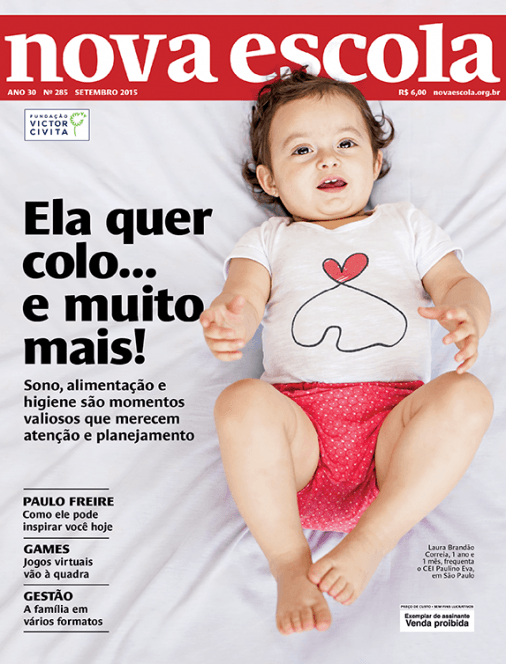
She wants to be held… and much more!
In early childhood, educators must feed, clean and put babies to sleep. These are valuable moments for children's devevolpment and must be taken seriously
Cover story for Nova Escola Magazine. September 2015.
As soon as they arrive at the CEI Paulino Eva, a daycare center in São Paulo, the babies go to play. Educators take the opportunity to interact and gather information to plan the day. They ask questions like “Did you sleep well, dear? Has your diaper already been changed? Are you hungry?” while observing the reactions. That way, they complement what was collected from whoever brings the children to school. During the conversation, teacher Maria Angélica Ferreira Barroso notices that one of the children is uncomfortable. She investigates a bit more and… “Hmm, that smells like a dirty diaper! Shall we change it?” With the girl in her arms, they head to the changing station and begin one of the most valuable moments of the day: the teacher changes the diaper and talks with the little girl, who doesn’t take her eyes off her. To make the most of everyday actions like this one in favor of children’s development, planning is required — which doesn’t always happen. “Many times, we see these activities being carried out mechanically, without the proper attention being paid to the baby,” says Damaris Maranhão of the Vera Cruz Higher Education Institute.
Part of the inattention to these aspects stems from the historical trajectory of this segment. The first institution geared toward this public was founded in Brazil in 1899. It was the daycare center at the Corcovado Textile Factory in Rio de Janeiro, which replicated the European model: its function was to care for the children of factory workers. The main concern was to ensure that the children would be healthy and safe. “There was an emphasis on the need to feed and clean them,” explains Anete Abramovicz, organizer of the book Estudos da Infância no Brasil: Encontros e Memórias.
This model survived for a long time and was legitimized by society. At the same time, research on early childhood showed how adult interventions impact children. German educator Friedrich Froebel (1782–1852) was a pioneer in this thinking. The kindergartens he created were replicated in Brazil starting in 1940, but they focused on the children of elites, in older age groups.
In the 20th century, the number of women in the workforce increased and the feminist movement gained strength. From being an employer benefit for a few, access to daycare centers was transformed into a right for mothers and young children. This shift in perspective culminated in the 1988 Constitution and the Law of Guidelines and Bases of National Education (LDB) of 1996, which enshrined daycare centers and preschools as part of the educational system. As a result, the requirement for teacher certification at the higher education level reached the professionals working in early childhood education. For this to happen, it is necessary to build consistent interactions, especially in moments of caregiving, when the child is alone with the teacher.
Another central aspect of these moments is that they foster the development of bonds. “By observing the educator and seeing that they interact with them, the child realizes that they exist in that person’s life,” says Rosa Mariotto of the Federal University of Paraná (UFPR). For young children, this bond means stability. “With a caregiver of reference, the baby does not fear being abandoned, recognizes the language and gestures used by that person, and feels calmer,” explains Mariana Americano of the Instituto Avisa Lá, in São Paulo.
A Conversation During Diaper Changes
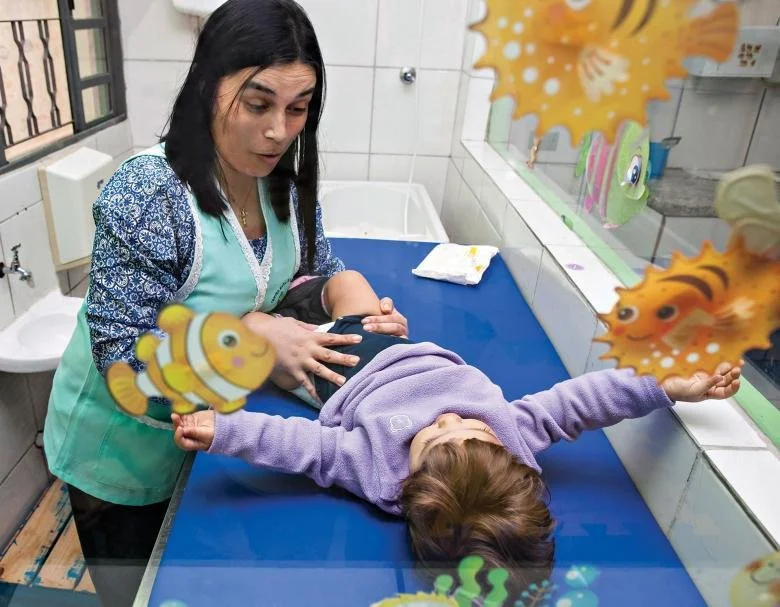
When Maria Angélica tells Laura Nogueira, 1 year and 4 months old, that she is going to change her diaper, she prepares the girl for what will happen. “Before starting, I ask permission. I ask: Can I take off your clothes? I’m dealing with the child’s body and it’s important that she feels respected,” she explains. Throughout the whole time, it is important to maintain a dialogue, be playful, be affectionate and avoid abrupt movements. Some of the care recommendations for these moments were outlined by Hungarian psychologist Anna Tardos of the Pikler Institute in the article “Being with Babies.” “The activity of getting dressed or being changed, repeated several times a day, can be a meeting filled with joy,” she argues.
In the article, Tardos advocates that educators ask for the child’s help. “Would they help? Yes. The baby would pay attention to what we do, would relax their arms and, with just a few months of age, would stretch their arms toward us when we showed them the piece of clothing. A real conversation can be established there,” she explains.
Hygiene aspects need to be noted to ensure everyone’s health. The changing station should be cleaned with soap and water at each diaper change. Products containing chlorine should be avoided due to the high risk of allergies and respiratory problems. The use of gloves — a subject of much debate among early childhood education professionals — is unnecessary in most cases, but they should be available to educators. The possibility of contamination does not come from direct skin contact with feces, but only if educators touch their faces with dirty hands. For this reason, it is important that, at the end of the change, everyone washes their hands again.
This ritual is another aspect that needs to be addressed from early on. Before meals, after playing in the park and after diaper changes, children should be taught to keep their hands clean. Applying soap, wetting the hands, rubbing them until a good lather forms and then rinsing are the main steps that should be explained to the group. This simple act can help dramatically reduce the incidence of common illnesses in daycare centers, such as colds and diarrhea.
Hygiene Checklist
“I prefer not to use gloves. They’re not necessary if we wash our hands. Besides, we don’t use them in interactions with other people, so babies would wonder: why with me?”
— Maria Angélica, teacher at CEI Paulino Eva• Talk to the child; ask permission before beginning the diaper change or bath and announce what you will do.
• Allow them to assist you by holding objects involved in the task or making body movements, like raising an arm to put on a shirt.
• Clean the changing station with soap and water before and after each diaper change.
• Wash your hands and the babies’ hands both times.
• Allow them to try blowing their own nose. If necessary, teach them to fold the tissue and blow one nostril at a time.
Mealtime Is Also a Cultural Experience
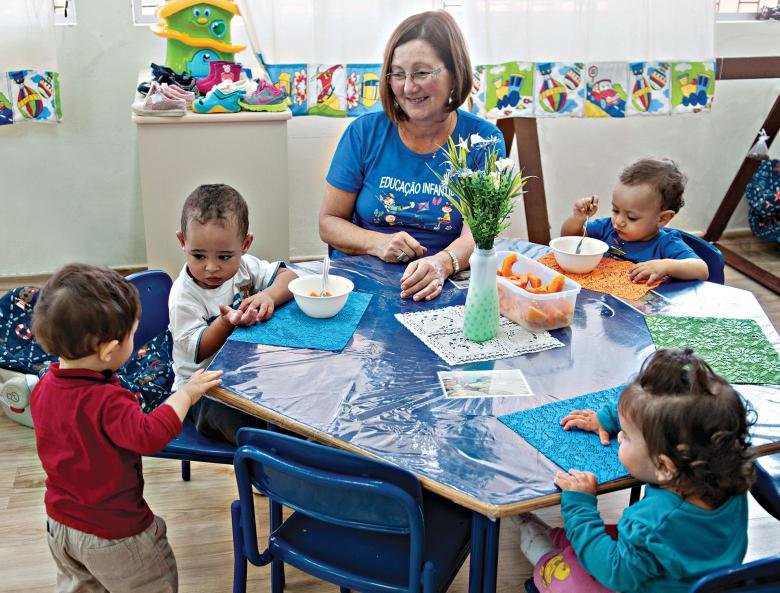
The mealtime space at the NEI Otilia Cruz, in Florianópolis, has the feel of a restaurant. The small table in the room for the group of 1-year-olds — ages 15 months to 21 months — is set by teacher Jacira Bosquetti Muniz and aides Rosemari Mosquetta and Andreza de Amorim: a tablecloth is spread, plates are arranged and soft music fills the room. “I believe this moment should be enjoyable and pleasant,” says Jacira.
The time set aside for meals is full of learning opportunities. If, in everyday life, adults eat at covered tables with decorations and use this time to socialize, it is important that babies have the opportunity to experience something similar at school. “One of the goals of the early stages of schooling is to show a bit of how things work in this world they are being introduced to,” says Eliana Sisla of the Instituto Avisa Lá.
The children sit in chairs sized for them, and the educators plate the food according to each child’s preferences and capabilities. The group is then divided: while some of the children eat with the help of one of the teachers, the others wait their turn with the other teacher. Some are already able to feed themselves. “They each have a spoon, and I use a separate utensil — a different one for each child — to help them when needed,” says Jacira.
Whenever possible, the school should seek the support of a nutritionist and follow the family’s guidance on feeding the young children. All of this information can be recorded on individual forms. Even so, challenges arise. When a child refuses to eat, you can offer the ingredients separately or in a different form. “If the refusal persists, the best thing to do is put the food away and try again later. It may simply be that the child is not hungry at that moment,” says Eliana.
Feeding Checklist
“At lunch, I talk and emphasize the importance of trying the food, if they make a face at something. Many times, when they notice that a classmate ate what they refused, they decide to try it.”
— Rosemari, aide at NEI Otilia Cruz• Allow children to try to eat on their own. Help them using a separate spoon.
• If they reject a food, offer alternatives, with the ingredients separated or in a different recipe.
• Prefer glass plates, as plastic ones can accumulate residue.
• Set up the environment to resemble adult mealtimes, with tablecloths and objects typically placed on the table.
• For those over 2 years old, set up a self-service buffet.
Throughout all the work, the collaboration of Andreza and Rosemari is essential for Jacira. The ratio of professionals to children and the training required to take on these roles varies according to the school system. The LDB requires at least a Normal Course at the secondary level, but it does not determine what position they should hold at the school. In practice, the aides — also called caregivers or floaters in some school systems — end up performing tasks considered to be of lower status or performing the same functions as the educators, but with lower pay and without the few guarantees secured for the teaching profession, such as dedicated planning time and ongoing professional development. They also greatly help ensure the minimum ratio required by law, which is six to eight children per adult for children up to age 2.
Jacira, Andreza and Rosemari all hold degrees in education. They work always as a team, despite their different roles, and share all functions. “Teachers tend to reject responsibilities linked to protection and care, because the image they formed of their profession is based exclusively on the activity of ‘teaching,’” warns researcher Maria Malta Campos of the Carlos Chagas Foundation. “The construction of a new teacher profile, appropriate for institutions serving young children, is therefore still in progress.”
Finally, Naptime
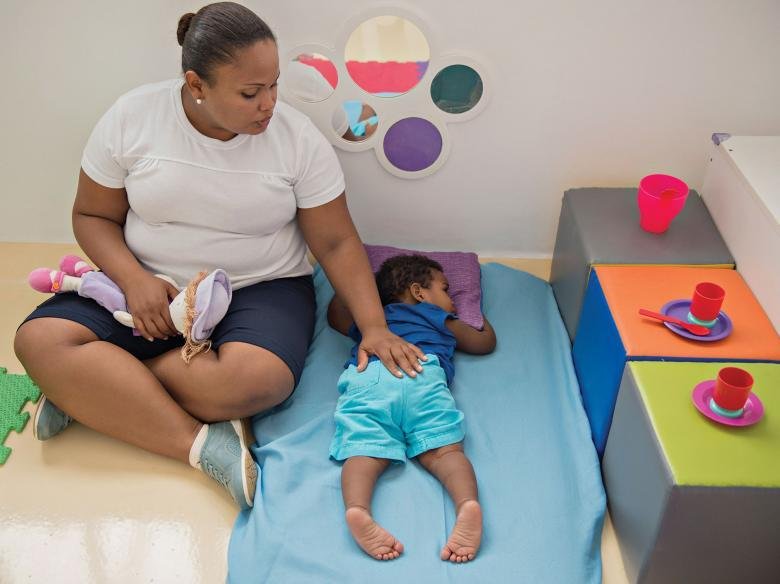
A day at a daycare center can be quite tiring — and that’s not just true for those who work there. Children also get exhausted, which is why sleep has its own dedicated time in the routine. For the nursery group at the Ceduc Bahia Daycare Center — which has a partnership with Avon, in the municipality of Simões Filho, 16 miles from Salvador — naptime comes right after play in the park and meals. When that moment arrives, the group starts to yawn and long for a few minutes in the cozy corner, set up with floor mats and cushions. It is there that nursery worker Eliane Maria de Santana and aide Luzinete Maria Martins lull the group to sleep. “We hold them, look them in the eyes and talk: ‘It’s time to rest; shall we sleep?’” says Eliane.
To ensure that the children fall asleep, exchanging information with parents is essential. “When a new child is enrolled, we ask how they are usually put to sleep at home and replicate that here. Gradually, we make adjustments,” she says. Family information is essential for planning work with babies. When dealing with familiar situations, they feel calmer.
Once they are asleep, the children go to a dedicated nap space. Again, hygiene precautions are fundamental. The main one is that each child has their own sheet and that the sheet is placed down at sleep time and removed right after they wake up. When stacking floor mats, the side that was in contact with the floor should not touch the surface where the sheet goes.
In the day-to-day of a daycare center, there are truly many details that ensure the group’s safety and well-being. But common sense is necessary. Some precautions are excessive. It is common to have children sleep in alternating positions — some face-up and some face-down. The justification would be to prevent the transmission of respiratory illnesses. “There is no research showing the effectiveness of that practice, but it is proven that a well-ventilated area and alternating between outdoor and indoor activities greatly help ensure the children’s health,” says Maranhão.
The daily routine normally concludes with a bath and preparation for going home. During the goodbye, carried out at the classroom door, the same procedures from the start of the morning are repeated. The educators have a quick conversation with the baby and whoever comes to pick them up about the events of the day. Everyone goes home whole, as happened in those pioneering daycare centers of the 19th century — but now, beyond cleanliness, they leave stimulated to interact more, to socialize and to return to face new challenges the next day.
Sleep Checklist
“We usually ask parents how they put the child to sleep. Then we try to do something similar — sing the same lullabies, for example — and we change things over time.”
— Eliane, nursery worker at the Ceduc Daycare Center• Set a fixed rest time, but also offer a space where the group can sleep at any time.
• Use individual sheets and remove them before stacking the floor mats, so that the side in contact with the floor does not touch the surface where the children sleep.
• Calm babies by speaking quietly, offering gentle touch and, if necessary, holding them.
• Use cribs only for children who move a lot during sleep. For others, floor mats and small foldable beds are the best options.
Originally published by Nova Escola. September 2015.
Reporter: Wellington Soares
Editor: Ana Ligia Scachetti
Original URL: novaescola.org.br/conteudo/8454/alimentar-limpar-e-ninar